ivo.sk
  search
On democratization of the European Union

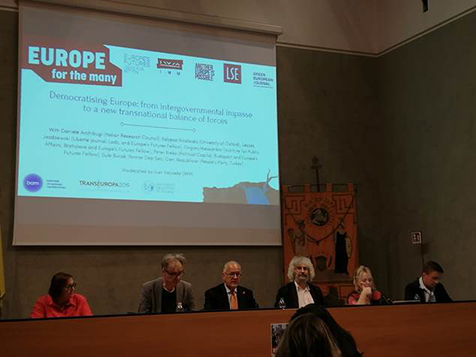
On 8 November 2019, President IVO Grigorij Mesežnikov, who, from September 2019 to June 2020, is a fellow at the Vienna Institute for Human Sciences – Institut für die Wissenschaften vom Menschen (IWM) at Europe’s Futures program, attended the Europe for the many conference in Palermo (Italy). 

The conference, a part of the "TransEuropa 2019. A Festival of Arts, Politics and Culture", was co-organized by the London School of Economics, IWM, European Alternatives, Another Europe is Possible, ERSTE Foundation, Green European Journal, University of Palermo and the City of Palermo. 

Discussants in a panel titled Democratizing Europe: from an intergovernmental impasse to a new transnational balance of forces included also Ivan Vejvoda (IWM), Daniele Archibugi (Italian Research Council), Kalypso Nicolaidis (University of Oxford), Leszek Jazdzewski (Liberté journal and Europe’s Futures Fellow), Sule Bucak (former Dep Sec. Gen. Republican People’s Party, Turkey). 

In his contribution and the following discussion, Grigorij Mesežnikov pointed out the link between the democratization and reform processes in Central European countries after the fall of the communist regimes with the process of European integration, the democratic value basis of the European Union and the need for its further development and strengthening.


>> Back to News

V4 is primarily based on cooperation in the domain of politics. But how is it perceived by the inhabitants of individual countries? 

Analysis of the situation and prospects for development in two areas related to Slovakia's attitudes towards Ukraine.

V4 at the Time of Polycrisis. Public Perception
Словаччина та Україна: перспективи співпраці та гравці

Attitudes of representatives of institutions and politicians towards Russian aggression & public opinion.

The key areas of the development of the country’s security and defence sector in 1993-2023.

Russia's war against Ukraine: A view from Slovakia
Thirty Years of Slovak Security and Defence Policy

Five case studies review Russian propaganda narratives and malign influence channels before the invasion in the first months of the war.

Exploring the extent, scope and prevalence of antisemitic prejudice in the four Visegrad countries. 

New Propaganda and Disinformation Challenges in the Changing Environment
Survey on Antisemitic Prejudice in the Visegrad Countries

Findings of a four-year research project on the foreign policy-related votes of MEPs. 

Inauthentic online behavior in the V4 concerning Russia’s war against Ukraine.

MEPs from CE: Bulwark against Authoritarianism
The Russia-Ukraine War in Social Media
Content © 2006 Inštitút pre verejné otázky.
Design © 2006 Komplot
Generated by Buxus content management system from ui42.


tlačiťposlaťhore