 On March 27, 2017, the Institute for Public Affairs organized a round-table in Bratislava on the topic European Youth – Skepticists or Fans? The participants of the event, representing several research and educational institutions and NGOs, discussed the findings of representative survey conducted among young respondents in six EU member states. The results of the survey were presented by Oľga Gyárfášová, project leader, subsequently the selected research findings were commented by IVO president Grigorij Mesežnikov.
A representative on-line opinion poll was conducted in the framework of international project on the sample of 3000 young people in the age of 15 – 24 years in Austria, Czech Republic, Germany, Hungary, Poland and Slovakia between 30 January and 13 February 2017. The survey was conducted for Bertelsmann Foundation in cooperation with the Polish Institute of Public Affairs (IPA, Warsaw) by the Kantar Public Agency (500 respondents selected for each country based on Eurostat statistics). Partners in other countries included the Institute of Human Science (IWM), Vienna; Institute for Public Affairs (IVO), Bratislava; STEM Institute, Prague and Political Capital Institute, Budapest.
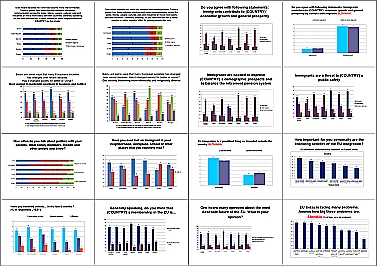
According to survey findings, more than three quarters of respondents (77%) in all 6 countries consider EU membership to be positive. The highest share of fans is in Germany – 87% of German respondents consider the EU to be “good thing”, followed by Austria (77%). However, in the Visegrad Four countries where the anti-European rhetoric of some governmental officials appears to some extent, the EU has many young supporters too (Poland: 76%, Slovakia: 70%, Czech Republic: 73%, Hungary: 79%). Slovakia has the largest share of young Euroscepticists (30%).
The chances to live and to work (66%) and to study (62%) in other EU countries is the second most valued contribution of the EU after the peaceful co-operation. For young Germans, it is a common European effort to combat climate change.
Youth not only wants to stay in the EU but also wants to reform it. The German and Austrian respondents were the strongest in their favoring of remaining in the EU and working on its reforming (Germany: 77%, Austria: 71%). In the V4 countries the idea of leaving the Union does not find high response among young people too. Even in Hungary, positive attitudes towards the EU are very high: 65% of young Hungarians, 64% of Polish and Slovak youth and 60% of young Czechs would choose to stay in the EU and to conduct the joint efforts to reform it.
For the vast majority of respondents (74%), Islamic fundamentalism and terrorism is the biggest problem that EU is today faced with. Among the six countries surveyed, young people in Poland have the greatest concerns about Islamic terrorism (83%) and migration (79%). Even young Germans see terrorism as the biggest threat (64%). However, the environmental pollution, climate change and the associated environmental disasters (63%) as well as increasing nationalism and xenophobia in Europe (60%) they consider as almost similarly big problems.
Download
Press release, in Slovak (pdf)
Presentation of results, in Slovak and English (pdf)
---
For more information, please visit the Bertelsmann Stiftung website Majority of young people in Central and Eastern Europe strongly backs the EU.


