On 19 February 2013, professors from leading universities and research institutes in five countries in Central and Eastern Europe (Bulgaria, Czech Republic, Poland, Romania and Slovakia) participated in a conference at the Université Libre de Bruxelles organised by the ALDE Party on weaknesses and potential for liberal parties in the region.
Following the fall of the Soviet Union, Central and Eastern Europe seemed like fertile soil for liberal ideas of freedom and human rights. Some twenty years later, the full potential of liberalism has only been realised in a few countries, leaving many countries without a properly functioning liberal party active in the respective parliaments and governments.
Thus, together with the professors, the ALDE Party embarked on a comprehensive research project, one of the first of its kind in the area. Its attempt was to analyse both the successes and missed opportunities of liberals in Central and Eastern Europe, as well as to point towards future electoral potential for parties active in these countries and, more broadly, in the concerned region.
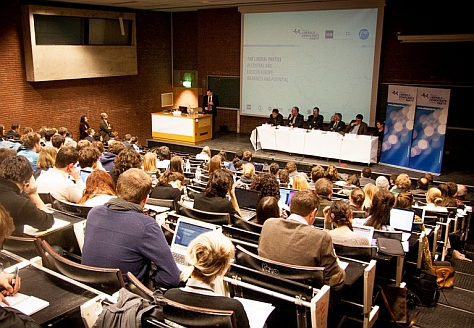
ALDE Party President Sir Graham Watson opened the conference by saying that: “This scientific research project is one of the first of its kind, and tries to analyse the weakness and potential of liberal parties and liberalism in five countries in the region. While there are natural differences between the countries, the findings of our professors and researchers point towards some striking similarities – and most importantly, it clearly points towards the potential of liberalism in the broader region.” He continued by saying: “If we are to get Europe back on track again, we will need to resist forces who are calling for a Europe à la carte where the best parts can be cherry picked and the worst parts left to others and instead focus on strengthening liberal reforms throughout Europe, be it in the area of human rights or economics. The European Union works best when working together. And, dare I say, with liberals at the helm.”
The following academics led the research project:
Jean-Michel De Waele, Dean of the Faculty of Social and Political Sciences of the Université Libre de Bruxelles (Belgium),
Blagovesta Cholova, project coordinator, Université Libre de Bruxelles
Antony Todorov, New Bulgarian University, Sofia, Bulgaria
Michel Perottino, Charles University, Prague, Czech Republic
Anna Paczesniak, Wroclaw University, Poland
Ovidiu Vaida, Babes-Bolyai University, Cluj-Napoca, Romania
Grigorij Mesežnikov, Institute for Public Affairs (IVO), Bratislava, Slovakia
From the side of the ALDE Party, political advisor Joakim Frantz led the overall coordination of this research project.
For more information, please visit aldeparty.eu.


